Why Mumbai Is India’s New BFSI-GCC Capital: A Micro-Market Guide For 2026

Introduction
For years, when a global bank or insurer said “GCC in India,” the reflexive answer was Bengaluru or Hyderabad.
That’s still true for technology-led GCCs. But a quieter shift has been building in the background, and 2026 is the year it became visible in the data: Mumbai is turning into India’s BFSI-GCC capital. The reasons behind it, though, aren’t obvious at first glance.
Here’s what’s actually happening, and where in the city it makes sense to land a GCC setup for a company.
What’s Actually Happening: Mumbai’s 2026 GCC Numbers
India’s office market leased 35.7 million sq. ft. of Grade A space in H1 2026, and Global Capability Centres accounted for a record share of that activity (44% as per reports), with quarterly GCC shares touching 45.5% in Q1 2026 alone.
Within that GCC wave, BFSI has been one of the two dominant sectors alongside technology, at times commanding a 20% share of quarterly leasing on its own, with Q1 2026 marking the BFSI sector’s highest-ever quarterly leasing volume.
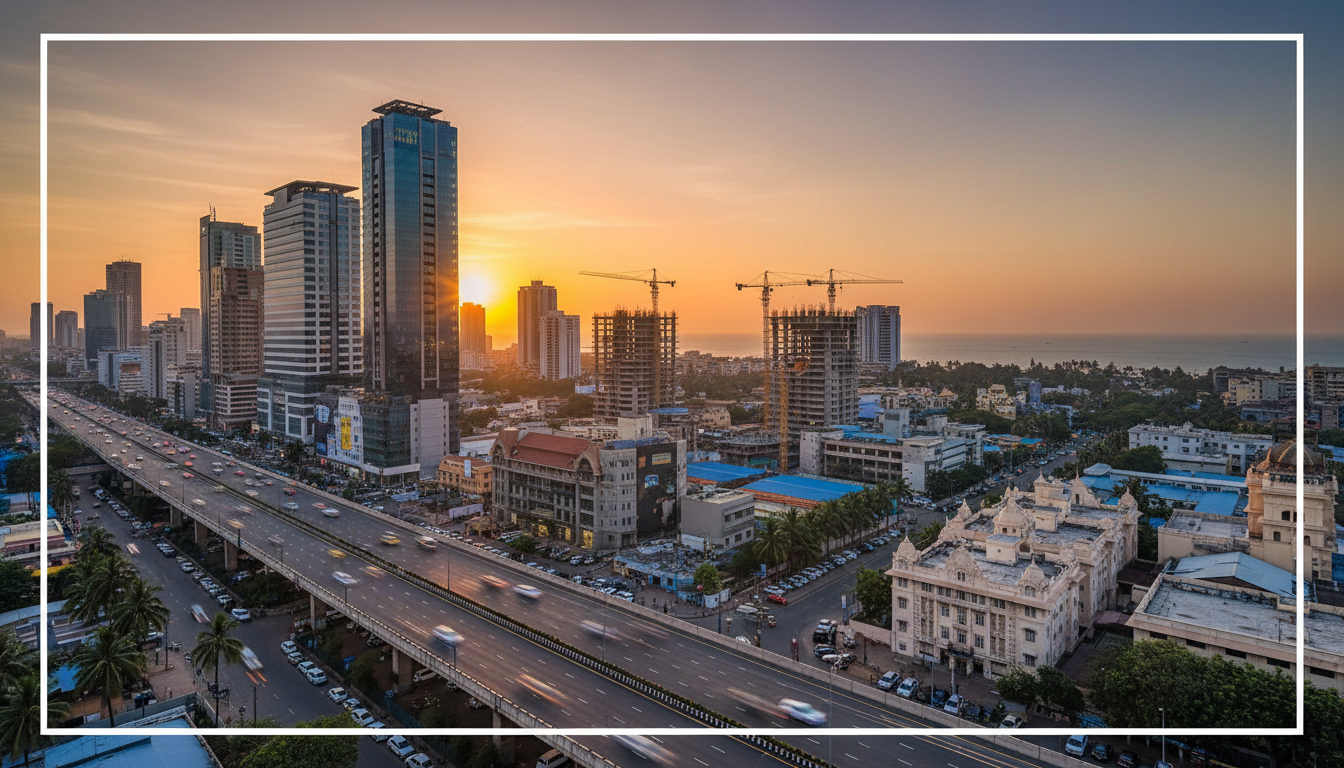
Mumbai’s specific position has firmed up. The city took a 19.5% share of India’s Q1 2026 gross leasing (strongest in years), and moved into single-digit vacancy territory, with prime business districts recording vacancy below 4%.
Rentals in the city rose modestly on a quarter-on-quarter basis even as Q2 saw a broader, cautious pause in large-ticket deals across the market. This reflects a structural pull: BFSI GCCs go where financial infrastructure, regulatory proximity, and specialised talent already exist; and that’s Mumbai’s prime advantage.
Why BFSI GCCs Are Choosing Mumbai
The short answer is financial ecosystem depth: Mumbai isn’t building a financial services identity, it already has the oldest one.
- The Reserve Bank of India, SEBI, both major stock exchanges, and the bulk of India’s private and foreign banks are headquartered or deeply embedded into the city. Built around risk, compliance, treasury, or regulatory reporting functions, proximity to this ecosystem shortens the distance between the GCC and major decision-making.
- A talent pool built for the mandate. BFSI GCCs usually don’t look forward to hiring generalist back-office staff. They actually lean toward actuarial science, credit risk modelling, regulatory reporting, quant research, and compliance technology. Mumbai’s density of finance graduates, chartered accountants, and professionals with prior BFSI-sector experience gives occupiers a shorter ramp-up than markets built primarily around IT/ITES talent.
- Grade A, green-certified supply is catching up. GCC procurement briefs increasingly demand LEED Gold/Platinum or IGBC-equivalent certification, large contiguous floor plates, and redundant power and connectivity as non-negotiables. Roughly 83% of India’s H1 2026 GCC leasing went into green-certified buildings. Mumbai’s newer stock, particularly in Navi Mumbai and BKC-adjacent developments, are increasingly built to this specification.
Mumbai’s Key BFSI-GCC Micro-Markets
Not all of Mumbai is equally suited to a BFSI GCC. Here’s how the leading micro-markets compare:
Micro-market | Best suited for | Rent range (₹/sq.ft./month) |
BKC | Front-office-adjacent GCCs, treasury, capital markets teams | ₹325–₹500+ |
Navi Mumbai (South) | Large-format, cost-optimised GCC campuses | ₹75–₹110 |
Powai / Eastern Suburbs | Mid-size GCCs balancing cost and talent access | ₹150–₹200 |
Andheri-Kurla Road | Connectivity-first back-office and shared-services GCCs | ₹135–₹200 |
What GCC Procurement Teams Actually Screen
What GCC Procurement Teams Actually Screen
GCC decisions rarely start with headcount. They start with a harder question about the city itself.
Before a floor plate or a building ever enters the conversation, the questions being asked at the top levels are consistent:
- What is the purpose of setting up a GCC in this region?
- What are the functions of this GCC going to be?
- Does the location have the infrastructure, depth, and talent pool to justify this as a business investment with exponential returns over the next 10 years?
Unless a city is already mandated, it tends to emerge from these questions rather than precede them. India’s GCC talent isn’t evenly distributed; specific cities carry specific infrastructure and specific talent bases. Mumbai’s natural lead in BFSI makes it a default choice for companies building out that function specifically.
Beyond city-level considerations, these are the standing requirements most often seen from companies setting up a BFSI-GCC in Mumbai:
- Floor plate: A minimum contiguous plate of 20,000–50,000 sq. ft. is now close to a baseline ask, not an aspiration.
- Certification: LEED Gold/Platinum or IGBC equivalent is frequently a hard filter before a building is even shortlisted.
- Scalability: Available expansion space within the same building or campus, to avoid a second relocation within 24 months.
- Infrastructure resilience: 100% power backup and redundant connectivity are treated as table stakes, not premium features.
- Lease structure: 5–7 year terms with a break option at Year 3 or Year 5 have become the standard ask, balancing long-term commitment with flexibility.
Conclusion
The story of Global Capability Centres in India has always been told through one city at a time: Bengaluru for engineering, Hyderabad for scale, Pune for cost efficiency.
Mumbai’s chapter reads differently, and perhaps more quietly, because it isn’t really a story about catching up. It’s a story about a financial capital finally being used for what it was always built for.
For a BFSI institution evaluating where its next captive centre should sit, the address matters less than the ecosystem around it; and increasingly, in Mumbai, that ecosystem is arriving pre-built.
Getting the micro-market right, though, is still a decision that rewards a second opinion. Citadel Propcon has been having exactly this conversation with BFSI occupiers scoping their India entry, and it’s usually a shorter conversation than people expect it to be.
FAQs
Why is Mumbai considered a BFSI-GCC hub in 2026?
Mumbai hosts India’s core financial infrastructure: RBI, SEBI, the major exchanges, and most global and domestic banks alongside a deep, finance-focused talent pool. In practice, that means a BFSI GCC here sits closer to the decisions it exists to support, which is usually the deciding factor once occupiers move past the initial city shortlist.Which is the best micro-market in Mumbai for a BFSI GCC?
It depends on what the GCC needs to sit close to. Front-office-adjacent or treasury-linked mandates tend to justify BKC’s premium; large-format, cost-optimised campuses do better in Navi Mumbai; Powai and the Eastern Suburbs suit teams balancing both. Getting this sequencing right, before the building search starts, is usually what separates a smooth setup from a costly mid-course correction.How does Mumbai compare to Bengaluru or Hyderabad for GCCs?
Bengaluru and Hyderabad remain the stronger choice for technology-led GCCs. Mumbai’s edge is specifically BFSI: banking, finance, insurance, and asset management functions that benefit from proximity to India’s financial regulators and markets. The right city depends on which function the GCC is built around, not a generic checklist.What rental range should a BFSI GCC budget for in Mumbai?
Headline rents span roughly ₹150–₹200 per sq. ft. per month in Powai to ₹325–₹500+ in BKC; but only rent rarely tells the full story.
It happens by modeling total occupancy cost, including CAM charges, fit-out, and escalation clauses, before finalising a budget.
What building specifications do BFSI GCCs typically require?
Most mandates ask for LEED Gold/Platinum or IGBC-equivalent certification, a contiguous floor plate of 20,000–50,000 sq. ft., 100% power backup, redundant connectivity, and 5–7 year lease terms with a break clause. Certification claims are worth verifying independently, not every building marketed as “green” holds up under scrutiny.How can Citadel Propcon help with GCC site selection in Mumbai?
We work with BFSI and other GCC mandates end-to-end talent-and-function mapping, micro-market and building shortlisting, lease negotiation, and compliance documentation. Most engagements start well before any building enters the picture, which tends to save clients from re-litigating the city decision later.