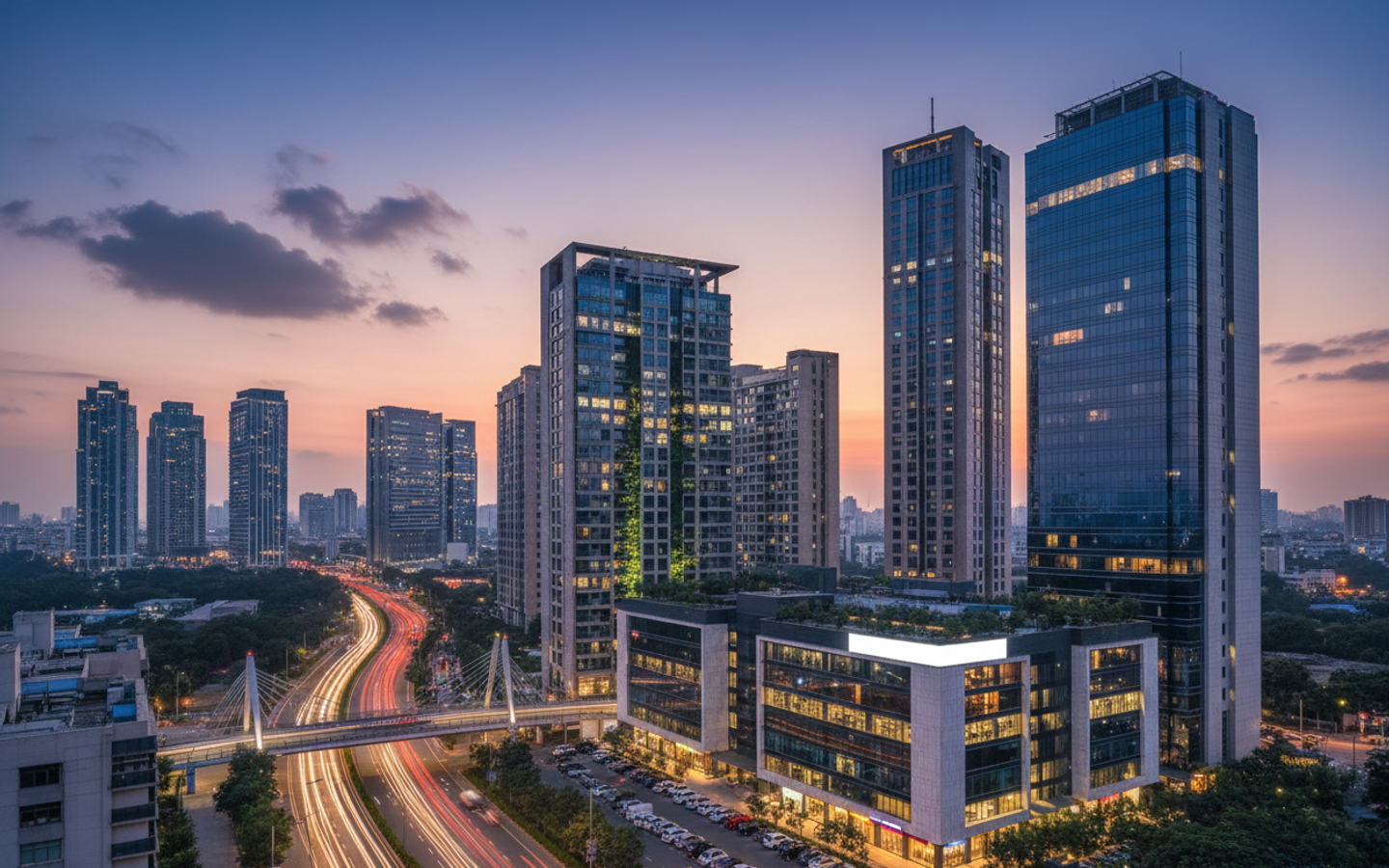
Chennai Commercial Real Estate Market 2026: Best Areas for Office Space, Coworking & Investment

The market for commercial real estate in Chennai has become more varied and competitive by 2026. Technology companies are still a considerable factor, but new entrants to the market are companies from fields such as engineering, manufacturing, banking, financial services and insurance (BFSI), global capability centers and flexible workspace providers. It is therefore clear that the choices available for the investors as well as occupiers have widened, because there are numerous options available for them in developed areas and emerging areas.
For companies seeking commercial real estate in Chennai, the critical issue that needs to be resolved is not just about office space availability but something much broader where issues such as talent accessibility, connectivity, building quality, rental costs, and scope for expansion have been considered.
Why Chennai Is Gaining More Attention?
Chennai possesses skilled labor, an established technology background, industry clusters, and the improvement in infrastructure. In addition, it has multiple well-established office corridors.
According to CBRE, the city is likely to go beyond 100 million square feet of office space availability by the end of 2026. Chennai has also registered around 6 million square feet of Grade A office absorption during the first nine months of 2022 as per Colliers.
This scale provides businesses in the market for office space in Chennai with larger options for campus developments, stand-alone properties, managed office spaces, and flexible workspaces.
OMR: Chennai’s Established Technology Corridor
Old Mahabalipuram Road remains one of the city’s best-known technology and IT corridors. OMR Zone 1, stretching from Madhya Kailash toward Perungudi, is also recognised as an important GCC micro-market.
The corridor suits technology companies, IT services firms, GCCs, and growing enterprises seeking talent and established office infrastructure.
Perungudi and nearby locations provide large office campuses, developments, and flexible workspace options. Businesses should compare road access, public transport, commute times, parking, and expansion space before signing.
Guindy: Strong Connectivity and Mixed Business Demand
The Guindy location offers the combination of central location and close access to the airport, metro, train services, industries, and residential catchment.
Therefore, it is suitable for tenants who would like to get office spaces in Chennai without relocating themselves far south to the technology corridor.
Guindy would suit consultants, technology firms, engineering firms, and corporate teams. It will be worth considering factors such as quality of construction, tenant composition, parking, and redevelopment options.
Mount-Poonamallee Road: A Growing Corporate Cluster
Mount-Poonamallee Road has emerged as another crucial business corridor, aided by corporate developments in the vicinity and easy access to residential and industrial areas of the western region.
Colliers names MPR as one of the important GCC micro-markets in Chennai and makes this corridor relevant for businesses in search of larger offices or planning to expand in the near future. The area offers its investors the chance to benefit from the alignment of demand, supply, and infrastructure development.
Taramani, Thoraipakkam and Pallavaram-Thoraipakkam Road
Thoraipakkam and Taramani are also connected closely with the technology ecosystem in Chennai. The Pallavaram-Thoraipakkam Road corridor is also of great significance as it connects residential areas, employment zones, and places near the airport.
Commercial property comparisons being made in the city should keep these corridors in mind if employees are located across the southern and southwestern regions.
The choice of property should rely on various factors like the number of employees in the team, the commuting practices, specifications of the property, and plans regarding the future rather than the popularity of the locations.
Coworking Is Becoming a Practical Portfolio Tool
Managed space solutions are not limited to startups. Large companies have been increasingly utilizing managed and coworking spaces to accommodate project teams, market entry, temporary growth, and distributed workforces.
This shift positively affects the demand for coworking space in Chennai because a business can start with a managed office and proceed to the dedicated one, without being required to shoulder the complete cost of fit-out from the very beginning.
When comparing flex options, check:
-
Seat pricing and inclusions
-
Lock-in and notice periods
-
Meeting room availability
-
Internet redundancy
-
Branding rights
-
Access hours
-
Expansion options
-
Security and visitor management
-
Parking and commute convenience
These details can affect the real cost and usability of the workspace.
What Investors Should Watch in 2026
Institutional investors are also flocking to Chennai. As per Colliers, about US$0.6 billion worth of real estate has been invested in Chennai in the first half of 2026, with a major part of the investments made into office spaces.
When studying Chennai’s real estate investments, it is important to consider more than just the yield statistics. Among others, the tenant profile, the remaining period of tenancy, rent increases, local vacancy levels, future supply, quality of the invested properties, and their liquidity should all be taken into account.
Choosing Between Conventional and Coworking Offices
It is not crucial for businesses to see conventional leasing and coworking as rival approaches.
A traditional lease offers more flexibility in terms of design, technology, branding and long-term residence. A coworking office in Chennai could be quicker to install, requires less investment in initial fit out and is more easily scalable.
The ideal method will be defined by the quantity of people in the organization, plans for the company and how quickly the office can start operating.
Conclusion
Chennai’s office market in 2026 offers choices across OMR, Guindy, Mount-Poonamallee Road, Taramani, Thoraipakkam, and other corridors. The city’s appeal is supported by technology, engineering, manufacturing, GCC activity, and a maturing flexible workspace sector.
For occupiers, choosing office space in Chennai should involve a review of employee access, infrastructure, total occupancy cost, and future expansion. For companies needing flexibility, coworking space in Chennai can provide a practical route into the market. Investors should focus on asset quality, tenant strength, documentation, and leasing depth.
Speak with Citadel Propcon to compare Chennai office, coworking, and investment opportunities across the city’s key commercial corridors.