Buying vs Leasing Office Space in Delhi: Which Is More Cost-Effective?
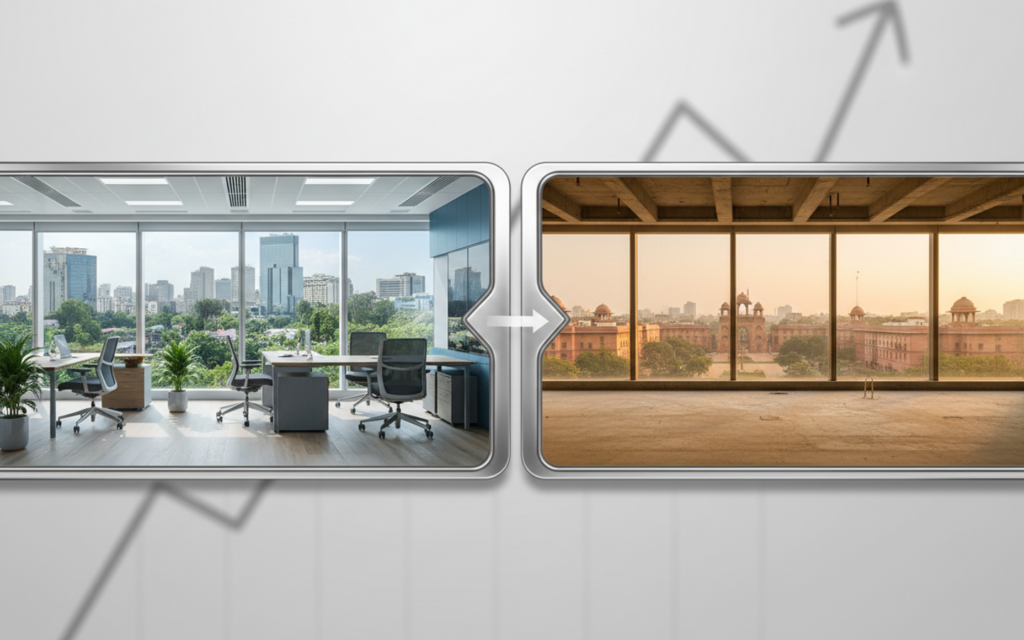
Choosing an office is not only about finding the right location or the right building. One of the biggest decisions a business has to make is whether to buy the workspace or lease it.
Delhi offers a wide mix of commercial properties across established business districts, emerging commercial zones, mixed use developments and corporate hubs. For the firms intending to operate in the city for a longer period of time, ownership and leasing might be financially feasible options. What matters is what the firm intends to achieve through expansion in future and its ability to invest and be flexible.
Firms interested in purchasing office space in Delhi are mostly going for the option of investing money in a building as a form of long term investment. Other firms choose to lease offices as a way of accessing more commercially viable sites without initial capital outflow.
But which is the cost effective solution?
Acquiring Office – Making an Investment for the Future
Purchasing an office means acquiring an ownership of a building. Instead of monthly rental payments, the firm makes investments in an asset which might appreciate in the future. It is especially suitable for companies which intend to stay on the site for a relatively long period of time.
The most important feature is stability. Property owners are not influenced by increasing costs and negotiation during the process of lease renewal. Moreover, the owners have the possibility of making changes in their office as needed.
A company can redesign workspaces, install specialised infrastructure, create branded interiors or make structural changes where permitted. There is also an investment angle. Businesses considering office space for sale in Delhi may benefit from potential capital appreciation if the property is located in a commercially strong area with good infrastructure and sustained demand.
However, ownership comes with significant upfront costs. Apart from the purchase price, businesses must account for registration charges, taxes, financing costs, interiors, maintenance, repairs and property management expenses.
This means buying may reduce flexibility in the short term because a substantial portion of the company’s capital becomes tied to real estate.
Leasing Office Space – Keeping the Business Flexible
Leasing works differently. Instead of purchasing the property, the company pays rent for an agreed period and uses the space under the terms of the lease.
The most obvious advantage is lower initial investment. A growing business may prefer to use available capital for hiring, technology, marketing, product development or expansion rather than purchasing commercial property.
Leasing can also provide access to premium business locations where buying property may require a much larger financial commitment. Another important advantage is scalability.
A company with 50 employees today may require space for 100 employees in three years. Leasing gives organisations greater flexibility to relocate, expand, consolidate or move to another micro market when business requirements change.
For startups, growing enterprises, project teams and companies entering Delhi for the first time, that flexibility can be financially valuable.
The downside is that rental payments do not create property ownership. Lease rates may also increase during renewals and companies may have restrictions on how extensively they can modify the premises.
Initial Cost – Leasing Usually Has the Advantage
If cost is measured only by the amount required to occupy an office immediately, leasing generally requires less capital.
Buying commercial property involves a large upfront payment or financing arrangement. A business exploring office space for sale in Delhi therefore needs to evaluate whether locking capital into property would limit other business investments.
Leasing normally involves deposits, brokerage where applicable, fit out expenses and recurring rent. For businesses prioritising liquidity, this can make leasing more attractive. However, initial cost alone does not determine the better financial decision.
Long Term Cost – Ownership Can Become More Attractive
The financial picture changes when a company expects to occupy the property for a long period. Lease payments continue as long as the company occupies rented premises. Depending on the agreement, rents may increase periodically.
Ownership involves a larger initial investment, but once financing obligations reduce or end, the company owns an underlying commercial asset. This is why the expected holding period matters.
A company planning to remain in Delhi for ten or fifteen years may evaluate property ownership very differently from a business that expects its workforce or location requirements to change within three years.
Flexibility vs Stability
The comparison ultimately comes down to two different business priorities. Leasing offers flexibility. Buying offers stability.
Companies that are growing at a rapid rate may not know their requirements for the amount of office space that they might require in the next five years. Purchasing a space that is smaller in size may result in expansion issues, while purchasing an unnecessarily large space would mean underusing capital.
Established companies with predictable workforce requirements may value permanent premises more highly. Businesses evaluating office space for sale in Delhi should therefore consider not just today’s headcount, but their expected workforce, operating model, client requirements and expansion strategy.
Consider the Total Occupancy Cost
A useful comparison should include more than purchase price versus monthly rent.
For ownership, businesses should evaluate financing costs, taxes, registration, maintenance, insurance, repairs, fit outs and opportunity cost of capital.
For leasing, the calculation should include rent, escalation clauses, security deposits, maintenance charges, fit out expenditure, lease tenure, lock in clauses and relocation costs.
The cheapest looking option at the beginning may not always be the most economical over the full occupancy period.
Which Option Makes More Sense for Your Business?
Buying may be suitable when a company has stable operations, sufficient capital, predictable space requirements and a long term commitment to Delhi.
Leasing may make more sense when flexibility, lower upfront expenditure, scalability and access to prime business locations are higher priorities.
There is no universal answer. The more useful question is: how will this property decision affect the company’s capital, operations, expansion plans and occupancy costs over the next five to ten years?
Conclusion
Buying and leasing office space serve different financial objectives. Ownership can help businesses create a long term asset and gain greater control over their workplace. Leasing can preserve capital and make it easier to adapt as business requirements change.
Before making a decision, companies should compare the complete financial impact of both options rather than focusing only on purchase price or monthly rent. The right choice is the one that supports both current operations and the company’s longer term commercial strategy.
Find the Right Office Space with Citadel
Whether you are evaluating an office purchase or comparing leasing opportunities, the right decision starts with understanding the market, property options, commercial terms and long term occupancy requirements.
Citadel helps businesses identify suitable commercial spaces, compare opportunities, evaluate locations and navigate office space transactions based on their operational and financial priorities.
Looking for the right office opportunity in Delhi? Contact us today to explore options aligned with your business requirements.