Managed Office vs Coworking vs Traditional Office: Which Workspace Model Is Right for Your Business?

Choosing out an office would normally be an easy task. A company finds a suitable commercial space, signs a lease agreement and occupies it. Nowadays, however, businesses are offered a wide variety of options. Citadel Propcon Pvt. Ltd. offers its services to companies looking for anything from traditional office spaces to flexible workspace solutions, based on the company’s size, growth prospects and needs.
The choice of a workspace solution is particularly important for Bangalore, where companies vary from start-ups to big Global Capability Centres (GCCs). Flexible workspace sector has also expanded its offer far beyond the startups niche. In the top eight Indian cities, approximately 191,306 flexible workspace seats were leased during the first half of 2026, which marks a 68.4% rise on annual terms. Among these, 57,487 seats, accounting for 30%, were leased in Bengaluru.
Which workspace solution is a good fit for your company?
What Is a Managed Office?
A managed office is usually a dedicated workspace created for one company but operated by a workspace provider. Instead of managing fit-out, furniture, utilities, housekeeping, internet and day-to-day facility requirements separately, businesses can take a more complete office solution under one commercial arrangement.
For companies searching for managed office space in Bangalore, this model can be useful when they need privacy and a stronger company identity but do not want to manage every stage of setting up and operating an office.
Layouts may also be configured around requirements such as meeting rooms, cabins, collaboration areas and team seating.
Managed offices have become particularly relevant for larger corporate occupiers. GCCs accounted for 44% of total flexible workspace seats leased in India during H1 2026. This indicates that flexible and managed workplaces are increasingly being used as part of enterprise real estate strategies rather than only for short-term requirements.
How Is Coworking Different?
Coworking is built around shared infrastructure.
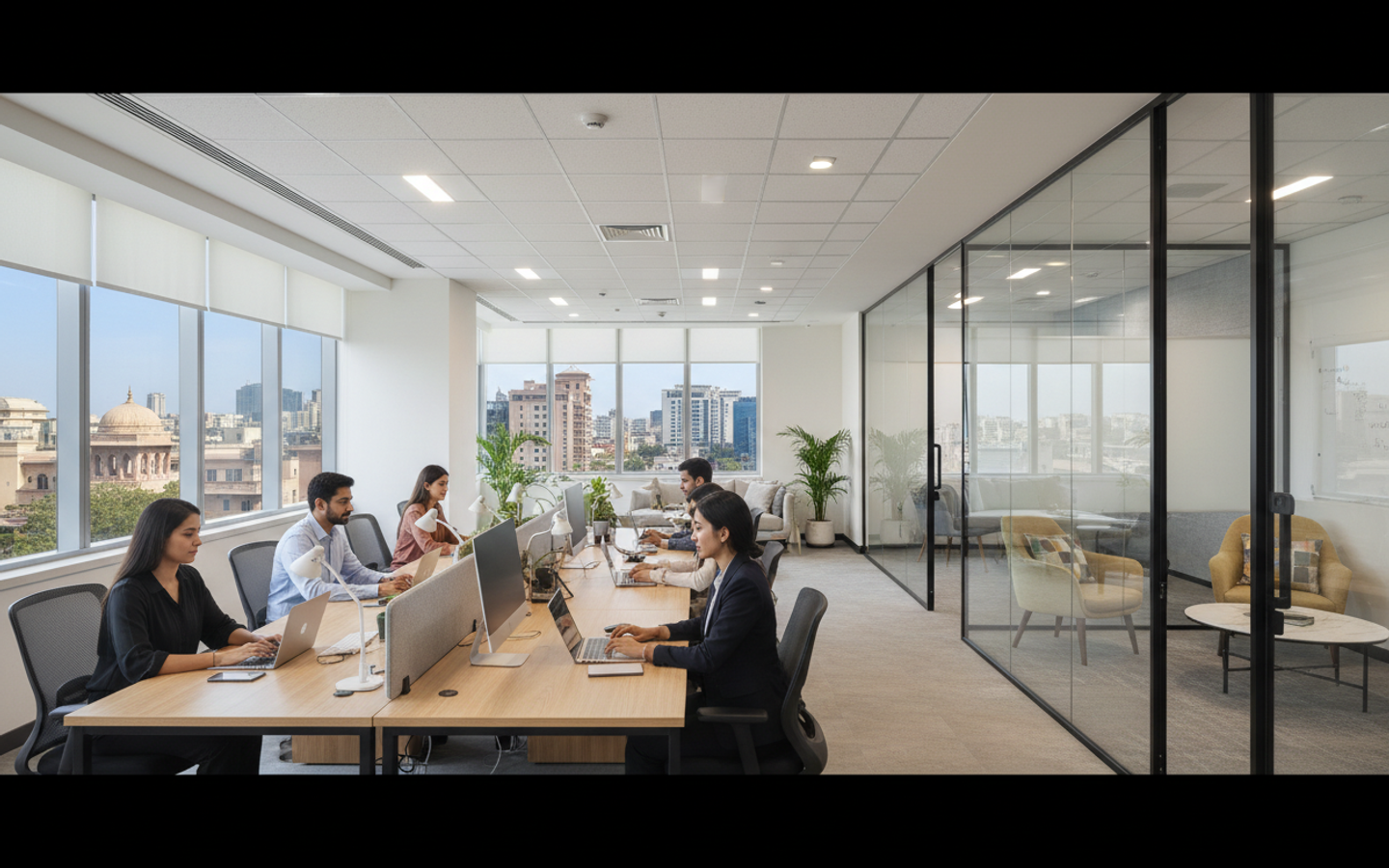
A business may have dedicated desks, cabins or a private office within a larger centre, while facilities such as reception areas, meeting rooms, breakout spaces, cafeterias and common areas are shared with other occupiers.
For smaller companies, project teams and businesses entering a new market, coworking space can make it easier to begin operations without committing to a large standalone office.
It can also offer flexibility when the headcount is changing. A business may begin with a small number of seats and add more as the team expands, subject to availability within the centre.
The main question is how much privacy and control the organisation requires. Shared infrastructure works well for many businesses, but companies handling sensitive operations or requiring extensive branding, specialised layouts or controlled access may prefer a dedicated managed office.
What About a Traditional Office Lease?
A traditional office gives the occupier greater direct control over the workplace.
The company generally leases commercial space from the landlord and then manages the process of designing, fitting out and operating the office. This allows considerably more freedom over workplace design, branding, technology, security and long-term space planning.
The trade-off is responsibility.
An occupier may need to manage fit-out investment, furniture, IT infrastructure, facilities, maintenance and multiple service providers. Conventional leases can also involve longer commitments than many flexible workspace arrangements.
That does not make traditional offices outdated. CBRE’s 2026 research notes that flexible workspace is increasingly complementing traditional leasing rather than replacing it. Many larger businesses now use a mix of conventional offices and flexible space across their wider property portfolios.
Managed Office vs Coworking vs Traditional Office
The differences become clearer when the three models are considered side by side.
| Requirement | Managed Office | Coworking | Traditional Office |
| Privacy | High | Moderate to high depending on format | High |
| Initial setup | Usually limited | Minimal | Significant |
| Customisation | Moderate to high | Limited | Highest |
| Shared facilities | Some | Common | Usually private |
| Operational management | Mostly handled by provider | Handled by provider | Mainly occupier responsibility |
| Expansion flexibility | Relatively flexible | Highly flexible | Depends on building and lease |
| Company branding | Usually possible | More limited | Full control |
| Typical suitability | Growing teams, enterprises, GCCs | Startups, small teams, project offices | Established long-term occupiers |
The right choice therefore depends less on company size alone and more on how the office needs to function.
When Does a Managed Office Make Sense?
Managed office space can prove highly beneficial for companies seeking a professional working environment without going through a lengthy process of organizing the office space.
In case a company starts its operations with its first office at Bangalore, it might need 100 seats now but expects that the team size will increase to 200 within a year. Renting out a big conventional office from the very beginning might leave you with empty seats, whereas a small co-working place might lack privacy and identity.
In such a case, a managed office space at Bangalore can be quite convenient between a co-working and conventional office lease.
This is one reason flexible offices are becoming part of larger corporate property strategies. Flexible workspace operators accounted for nearly 20% of India’s overall office leasing activity during H1 2026, compared with 13% in H1 2025.
When Is Coworking the Better Choice?
Coworking can be practical for companies that value speed and flexibility over extensive workplace customisation.
It can suit:
- small teams entering Bangalore
- startups with changing headcount
- temporary project teams
- satellite offices
- businesses testing a new market before making a longer commitment
A coworking space can be particularly useful when a team needs an operational workplace quickly and future headcount is still uncertain. The ability to occupy desks without first managing a complete fit-out can reduce both setup time and initial complexity.
When Would It Make Sense to Rent a Traditional Office?
In general, traditional leasing will seem more appealing where the company is fairly certain about its employee base and plans on being at that place for a longer duration.
This can also happen where there are special requirements for the office in terms of security, infrastructure, design, or branding.
The decision should still be based on total occupancy cost rather than rent alone. Fit-out expenditure, maintenance, utilities, facility staffing, technology and eventual expansion requirements all affect the real cost of occupying an office.
Choose the Workspace Around Your Business Plan
There is no workspace model that is automatically right for every organisation.
A coworking setup may be ideal for a 15-person market-entry team. A managed office may work better for a rapidly expanding 200-person operation. A traditional lease may make more sense for an established business planning to occupy the same workplace for several years.
The starting point should therefore be the business plan: current headcount, projected growth, preferred location, privacy requirements, capital expenditure, customisation and the length of commitment the company is comfortable making.
This shift towards mixed portfolio strategies is also reflected in occupier research. Around 67% of respondents expect flexible workspaces to form part of their office portfolio within the next two years.
Citadel Propcon Pvt. Ltd. helps businesses compare managed offices, coworking options, flexible workspace solutions and conventional commercial offices across Bangalore. It’s not just about finding an available space, but rather finding a workplace concept that will suit the business in terms of number of people working there, its needs, budget, etc.
Get in touch with us to find a perfect workspace for your business in Bangalore!